



|
Getting your Trinity Audio player ready...
|
This story has been udpated.
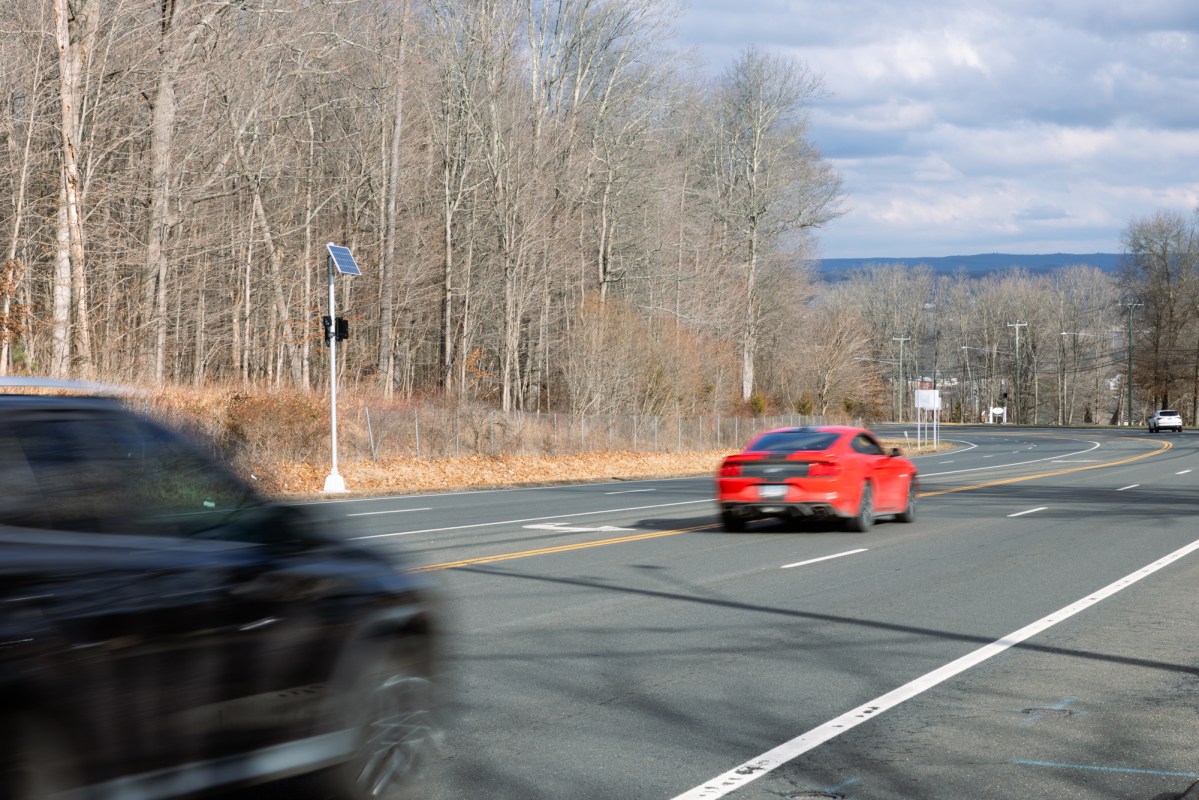
Drivers who speed down Route 66 on the border of Middletown and Middlefield are getting hit with an automatic $50 fine. The second time they’re caught in a month costs $75.
Middletown is one of the first municipalities in Connecticut to install speed cameras in town — but it won’t be the last. After the Connecticut legislature passed a law in 2023 allowing municipalities to install red light and speed cameras and collect fines from drivers who break the law, cities and towns have been presenting extensive plans to the state Department of Transportation in bids to procure their own monitoring devices. So far, 11 have had plans approved and three more are under consideration.
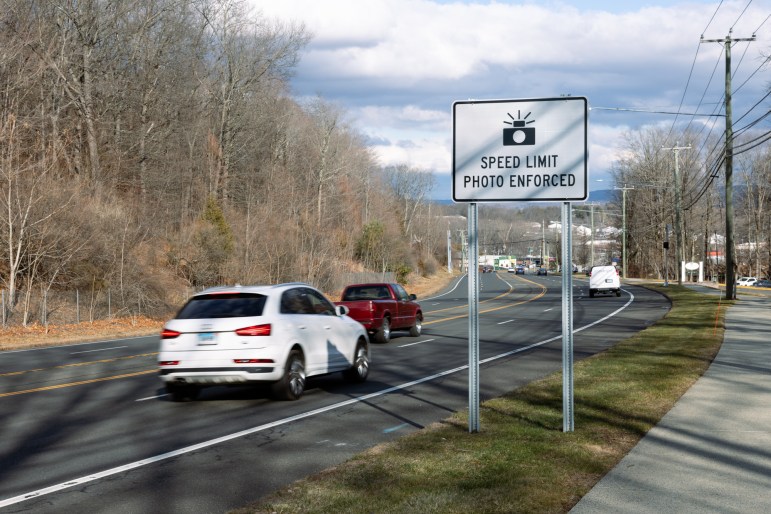
The 2023 law says that municipalities can install cameras that will capture drivers who speed and run red lights. After an initial 30-day period of written warnings, drivers who drive more than 10 mph over the speed limit or run a red light will be issued a fine.
According to the Middletown police, the area on Route 66 near the camera is a hotspot for speeders. The limit is 35 mph, but the police have caught drivers going more than twice as fast.
Middletown Police Chief Erik Costa said he would need significantly more police officers to catch as many people speeding as the camera was able to. He said it has also “changed the culture” of driving in that part of the city, where there are multiple apartment buildings and large retail stores.
Towns that want to install speed cameras have to create plans that include quite a bit of information, including data on traffic stops and crashes in the areas where the proposed cameras would be installed.
According to Middletown’s plan, the police department made 455 traffic stops over the last three years in the area on Route 66 where the camera was to be located.
From the time the camera went live in July through December 2025, the department issued about 46,000 citations for the same area. As of early December, the department had collected $1.84 million in fines out of a total of $2.8 million issued, according to Costa.
“ The force multiplier that the cameras take care of is tremendous,” Costa said.
Costa said the cameras have allowed him to send his police officers to patrol other “hot spots” in town.
The town recently installed two more traffic cameras, near Spencer and Moody elementary schools. Costa said the areas near those schools have no lighting or stop signs for controlling traffic. The roads slope downward and the intersections are at odd angles, making the cameras necessary.
“ We really are focused on maintaining good speeds in that area so we don’t have any tragedy and especially during the transition of our buses and family pickup for students,” he said.
‘The only thing … that has actually worked’
So far, the state has approved traffic cameras in 11 municipalities — New Haven, Middletown, Washington, Beacon Falls, Marlborough, Milford, Stratford, Fairfield, Greenwich, Stamford and Wethersfield.
The municipality of Washington, a town in Litchfield County with a population of about 3,600 in 2021, was the first to install cameras. The plan submitted to the state said because Washington shares a resident state trooper with surrounding towns, the town needs additional resources in order to enforce traffic laws.
Richard Inniamo, Washington’s resident state trooper, said in early December that the town’s three cameras had issued upwards of 13,400 citations since May of last year.
“People are slowing down for them, and that’s all we really wanted,” Inniamo said. He added that where people used to travel more than 20 mph over the speed limit, they are now staying within 10 mph to 15 mph of the speed limit.
According to Jim Brinton, Washington’s first selectman, in early December the town had collected roughly 75%of the $662,000 it has issued in fines. Brinton agreed with Inniamo that the cameras have slowed down drivers. He said citations peaked in June, a month after the cameras were installed. Since then, the number has dropped.
“Honestly, it’s the only thing to date that has actually worked,” Brinton said, adding that the town had tried installing speed bumps, and offering more education, to no avail.
Brinton said the town saw the cameras as a way to improve pedestrian safety, a top concern.
“As a rural community, we’ve got people out constantly with their children with their pets walking the roads. It was virtually every road was a speedway,” he said.
Data from Marlborough shows that the two cameras installed on North Main Street caught 8,600 speeding events between July and December 2025 and issued 6,500 citations. According to a presentation that Town Manager David Porter gave to the Capitol Region Council of Governments, the percentage of people driving over the speed limit dropped significantly when the cameras were installed and continued to drop over the course of the first few months they were active.
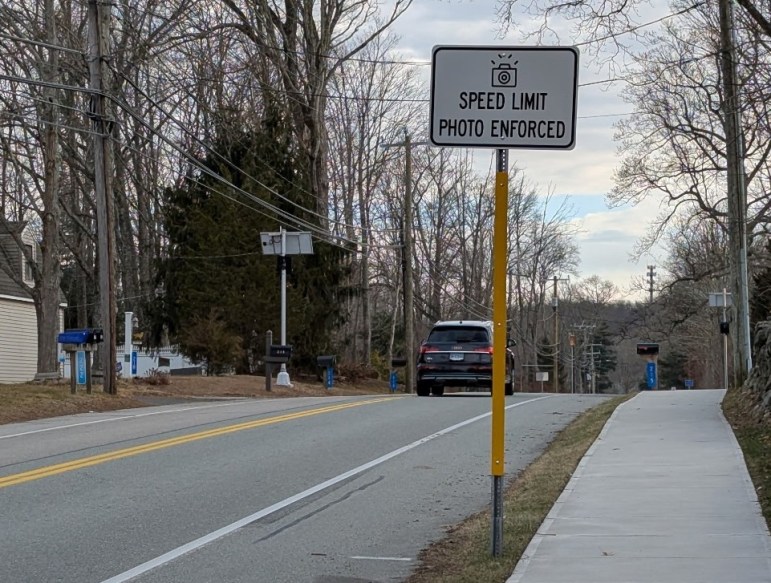
“Speed cameras have been enormously successful at making that road much safer,” Porter told the Board of Selectmen at a meeting on Dec. 16.
But Porter also said that state rules requiring the data to be erased after 30 days made it difficult to keep track of repeat offenders. He said he would like to see the time limit increased to 60 or 90 days.
So far, he said, the town has collected $186,924 after paying fees to the camera vendor.
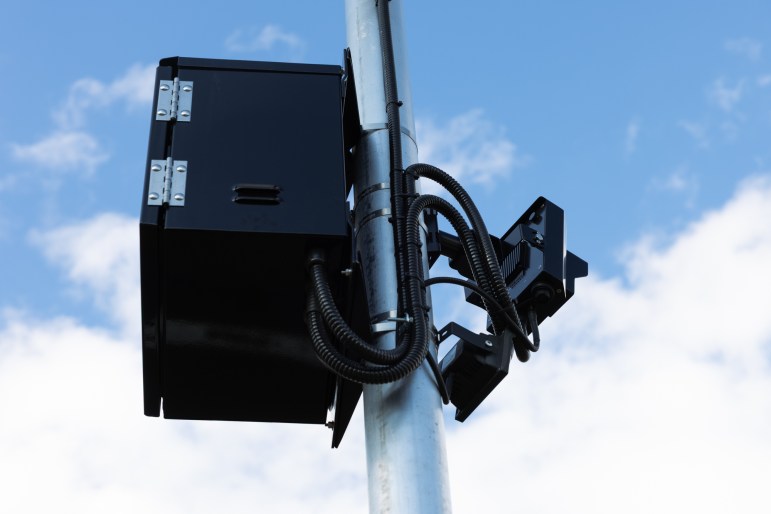
The towns have contracted with a variety of vendors to provide the cameras and software. A purchase order from August 2024 shows that Middletown paid about $3,900 to the firm Traffic Logix for a speed camera. The town paid $4,000 to Dacra Tech for the camera’s operating system and will also pay the firm a monthly fee based on the number of citations and warnings issued: $13.50 per citation and $6 per warning.
Costa said the cost of the speed cameras will be funded by fees from violations. Under the 2023 law, fees collected from traffic violations must go either toward paying for the speed and red light cameras or toward transportation infrastructure.
Privacy concerns
Privacy concerns have been raised, not only with the use of red light and speed cameras but with all surveillance technology.
Late last year, the ACLU called for a temporary ban on automatic license plate readers out of concerns the information the devices collect could be used by federal agents for immigration enforcement or to penalize people seeking abortions or transgender care.
Although Connecticut’s law strictly regulates the way data collected by speed and red light cameras can be used, Dan Barrett, the legal director of the ACLU of Connecticut, said the organization is concerned about their use.
“The pervasive surveillance means that so much more evil is possible,” Barrett said.
State law mandates that any data collected by speed or red light cameras can only be used to track those violations. It can’t be used, for example, to track someone who has committed a crime.
Still, some municipal officials, while assessing the need for the cameras, have expressed concerns about potential collateral effects.
In September, the town of East Hartford approved a detailed ordinance regulating all surveillance technologies, including license plate readers, speed and red light cameras and drones. Don Bell, the town council vice chair, said at the council’s September meeting that the strict state regulations around speed and red light camera data helped quell his fears that the program might overcharge or discriminate against certain residents.
Still, he said, he felt some “discomfort” about the use of the devices.
“We know that surveillance technology, good intentions or not, often disproportionately impacts communities of color. As one of the most diverse communities in the state, throughout this process I’ve worried if I might unintentionally hurt East Hartford by supporting any ordinance that opens the door for new technology,” Bell said.
The ordinance places regulations around surveillance cameras that are similar to the ones the state places on speed and red light cameras, limiting the way the data can be used and how long it can be kept. The ordinance also prohibits the use of facial recognition technology.
The town has not yet proposed installing any red light or speed cameras.
People who receive citations are able to contest them and ask for a hearing. There are six valid reasons under the law for overturning violations: if a traffic light was broken, a driver had to get out of the way of an emergency vehicle, a driver was directed to ignore the traffic light by an officer, the camera was calibrated incorrectly, the vehicle in question had been stolen or the vehicle was an emergency vehicle.
The citations are civil violations, meaning that drivers will not receive points on their licenses, and the violations will not be reported to insurance companies.
New Haven
Connecticut’s largest cities have also started to invest in the technology.
The New Haven town council voted in November to approve a contract with the firm NovoaGlobal to install traffic cameras. The city applied to install 19 red light and speed cameras at various intersections. The state Department of Transportation approved 15 of the 19 requested.
Overall, New Haven was the site of 20,000 crashes between 2020 and 2022, including about 250 in which someone was seriously injured and 58 in which someone was killed, according to the plan New Haven submitted to DOT.
Several of the sites the city chose for the cameras were locations where pedestrians had been struck and killed by motor vehicles in the last five years.
At one of the intersections, where Martin Luther King Jr. Blvd crosses Church Street, more than 70 crashes occurred between 2020 and 2022. In 2024, a bicyclist was hit by a garbage truck and killed at the intersection, and a pedestrian was injured during a crash in which one vehicle ran a red light.
Mayor Justin Elicker said the traffic cameras were one tool in a larger plan to curb traffic accidents in New Haven. He said the city has doubled the number of officers assigned to traffic enforcement and is installing speed bumps and modifying roads to slow drivers down. The city is also installing cameras on school buses that record drivers passing buses when they’re stopped.
“In general, there’s still dangerous driving, but we have seen a lot of progress overall in the city,” Elicker said.
Elicker said the cameras were an advantage not just because they were able to monitor traffic 24/7 but because certain intersections made it difficult for a police officer to pull someone over even if the officer happened to witness a violation.
“ The cameras are not just helpful to have more enforcement eyes on the street but also to keep our officers and community members safe,” Elicker said.
Hartford
While the state has not yet approved its application, the Hartford city council voted in November in favor of a plan to install traffic cameras at 11 locations near schools in the city.
According to the proposal the city submitted to the state Department of Transportation, multiple pedestrians had been killed at the potential camera site on Main Street near S.A.N.D. Academy in the past two years. Other potential locations were places where drivers had put students at risk, like at the Parkville Community School.
“School staff report that students crossing Park Street near New Park Avenue have experienced near misses with speeding drivers,” the report noted.
In an area on Wethersfield Avenue near Burr Middle School and Bulkeley High School, more than 100 crashes had taken place within the prior three years, according to the proposal.
Hartford Mayor Arunan Arulampalam told CT Mirror that the city saw the 11 cameras as a pilot program. He said that focusing on the schools would improve multiple neighborhoods across the city and prioritize the safety of children.
“ I’ve heard time and time again from families about the toll that reckless driving has taken. And as we all know, it’s gotten so much worse after COVID,” he said. “ We want to be able to have residents feel safe in every neighborhood that they’re in across the city and driving is clearly a major public safety concern.”
“I think actually that [the cameras] will disproportionately help victims of color, and I think we’re going to find a mix of folks from outside of Hartford who are perpetuating many of these traffic violations,” he said.
Bridgeport
Other cities remain skeptical. On Jan. 6, members of the Bridgeport city council’s Public Safety Committee gathered to hear a presentation raising the possibility of installing speed cameras at several intersections in the city.
Councilwoman Maria Valle said her goddaughter had been struck at an intersection on East Main Street. She told the Connecticut Mirror that she supported the idea of speed cameras because “something’s got to give.” She mentioned flowers that would appear at intersections, signifying that someone had been killed there.
“If it’s going to help our residents, why not?” she said.
But others said they wanted to see the money used to bolster resources that were already suffering from funding shortages in the city.
“ We are in a place right now that we don’t even have officers to solve crime,” said councilwoman Eneida Martinez, who questioned whether the city would have enough personnel to monitor the cameras, as well as the drones the city has approved to alert law enforcement and first responders to emergencies.
Constance Vickers, the mayor’s deputy chief of staff, told the council members that she felt the cameras would improve safety.
“ I live right on one of these intersections. I see accidents every day. I walked to work through one of them,” she said.
Slowing people down
It may be too soon to say whether the municipal cameras have reduced the number of vehicular fatalities in the state.
The Connecticut Transportation Institute at the University of Connecticut found that last year, 270 traffic-related deaths were recorded across the state. That was a notable drop from the previous three years, where deaths ranged from 308 to 366 people.
Eric Jackson, the institute’s executive director, said there had been a renewed focus among police departments on ticketing speeders and aggressive drivers.
“It could just be the talk of automated enforcement has people slowing down,” Jackson said.
While the number of drivers and passengers in vehicles who were killed was lower in 2025 compared to previous years, the number of pedestrians who died in crashes remained relatively consistent.
Jackson said the numbers reflect a nationwide trend of pedestrian deaths increasing over the last decade, a trend bolstered by increased aggressive driving during the pandemic. He said the crashes have become more deadly for pedestrians as average vehicle sizes increase.
Speed cameras can lead to improved safety at particular hot spots, Jackson said. He said cities and towns should also be thinking about road infrastructure, providing wide crosswalks, installing poles and bump-out curbs and making sure there is enough lighting.
In 2023, the state Department of Transportation ran a pilot program placing speed cameras at five work zones. The program issued more than 24,900 warning notices but issued fewer than 750 fines. A 2024 report to state lawmakers found that the cameras reduced vehicles’ speed in the work zone — in some cases, up to 18%.
“Based on the results of the pilot, and what we heard directly from the men and women on these job sites, yes, the pilot was a success. Speeds dropped and workers felt safer when these devices were active,” Josh Morgan, spokesperson for the department, said in an email.
The state resumed the program in the fall of 2025, although it has not yet begun enforcement.
Correction:
An earlier version of this story misspelled Jim Brinton’s name.
